Financial Services
Public Sector
AI Risk Intelligence · Financial Services











2M+
entities evaluated in large-scale agentic deployments
$177.9M
annual savings potential for tier 1 banks - Celent
95%
productivity improvement vs legacy screening
100%
auditability on every decision

“We tested several vendors to improve our AML/KYC processes with external data. Quantifind beat out the competition with its strong data science foundation that leads to superior speed and accuracy.”
“Quantifind demonstrated how AI agents could improve the consistency and accuracy of financial crime decisions while reducing manual work by 60%—freeing analysts to focus on higher-value investigations without compromising our risk policies.”
One intelligence platform. Built for the accuracy, scale, speed, and explainability your institution demands.
Solutions
Graphyte brings precise, actionable intelligence across the financial crime lifecycle — helping your teams find risk earlier and act faster

The Legacy Tradeoff
Legacy screening forces an impossible tradeoff. Tune for coverage, and you overwhelm your analysts with noise. Tune for efficiency, and you increase the risk of missing critical threats.
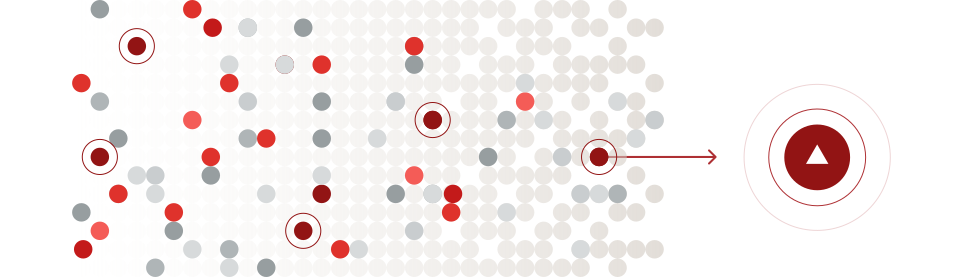
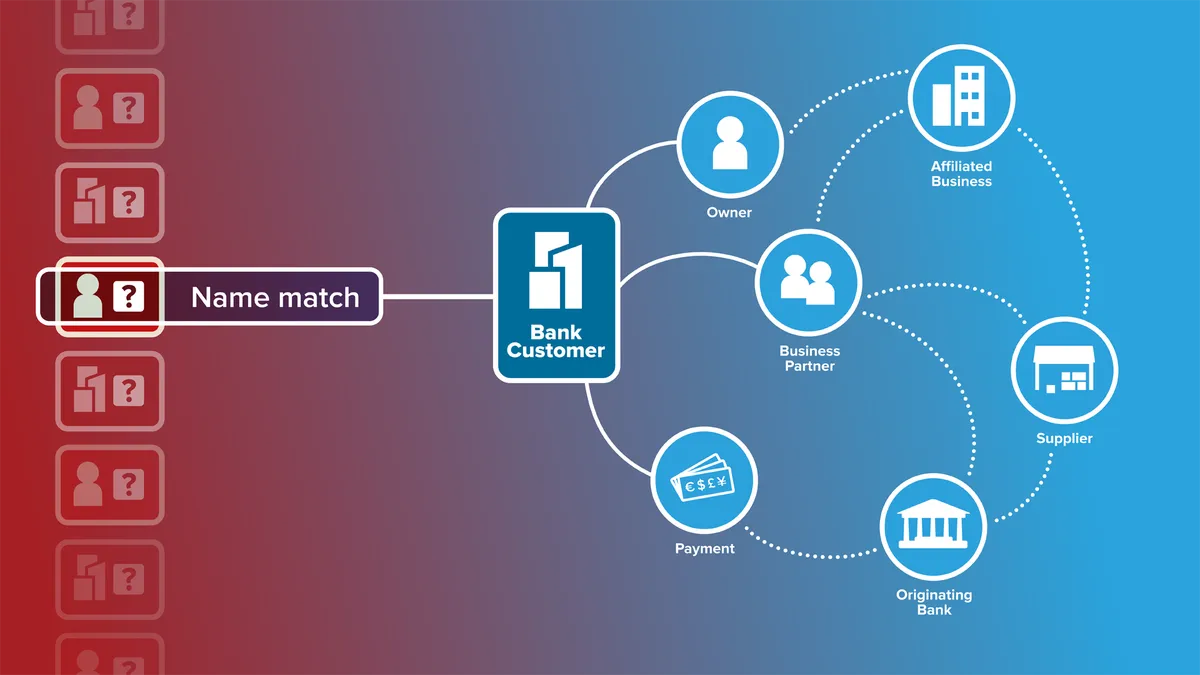
Name Science™ resolves the right person, company, or vessel across spellings, aliases, and transliterations. Our Global Name Rarity Model provides a unique precision layer: identifying "Very Rare" names with an 80% probability of uniqueness in a given region, while flagging "Very Common" names shared by 200+ organizations. This is the difference between blocking a payment and blocking your customer.
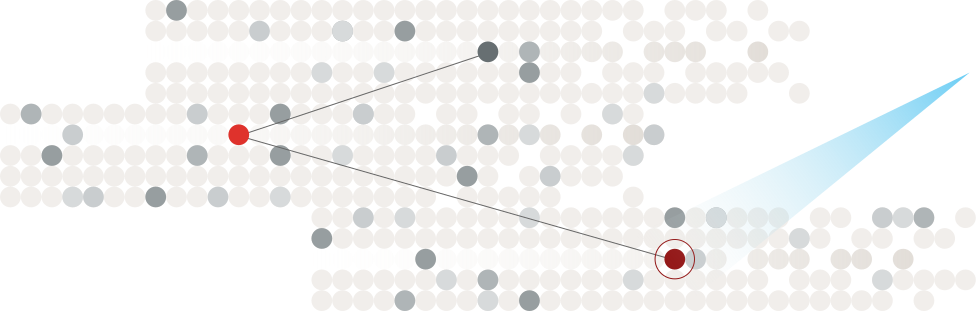
Network Graph Intelligence maps the ownership and relationships behind every counterparty. Our Quantifind Knowledge Graph (QKG) automates relationship extraction and profile rollups across disparate sources, including 4M+ Chinese companies with international operations and 25k+ sanctioned profiles.
By integrating global company intelligence databases—such as S&P, state-owned entities, and global registries—we provide real-time and batch network expansion to uncover critical FOCI relationship risks.
An award-winning typology library and 60+ AI/ML models score the signal for sanctions & enforcement, industry-based risks, criminal typology risk, and network-based risk. Graphyte goes beyond just risk detection and establishes context-based Entity-Risk Relevance.
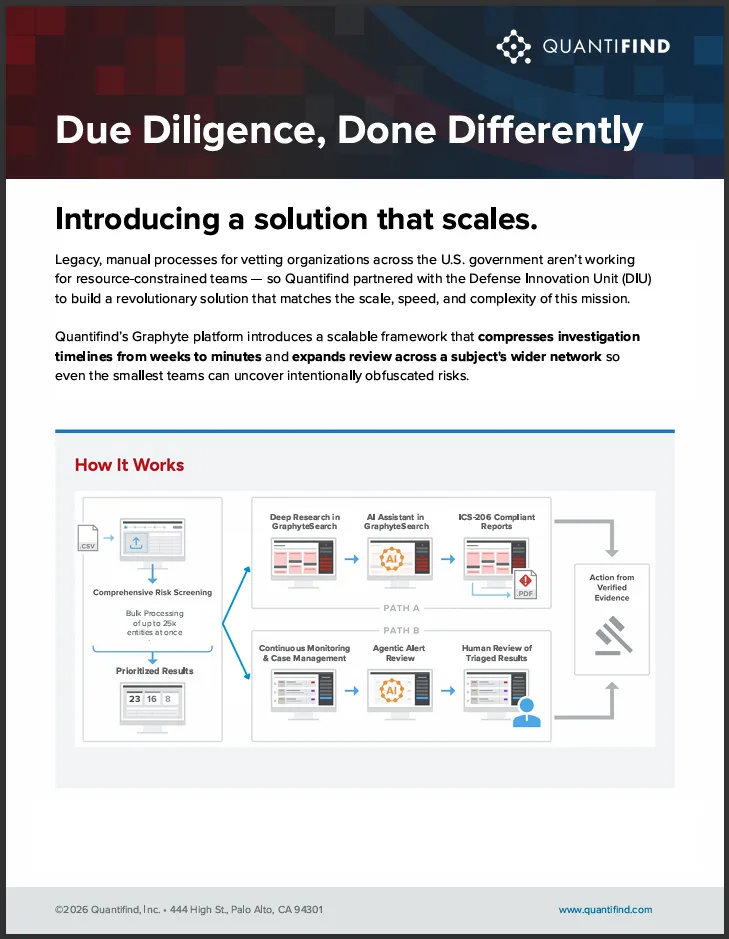
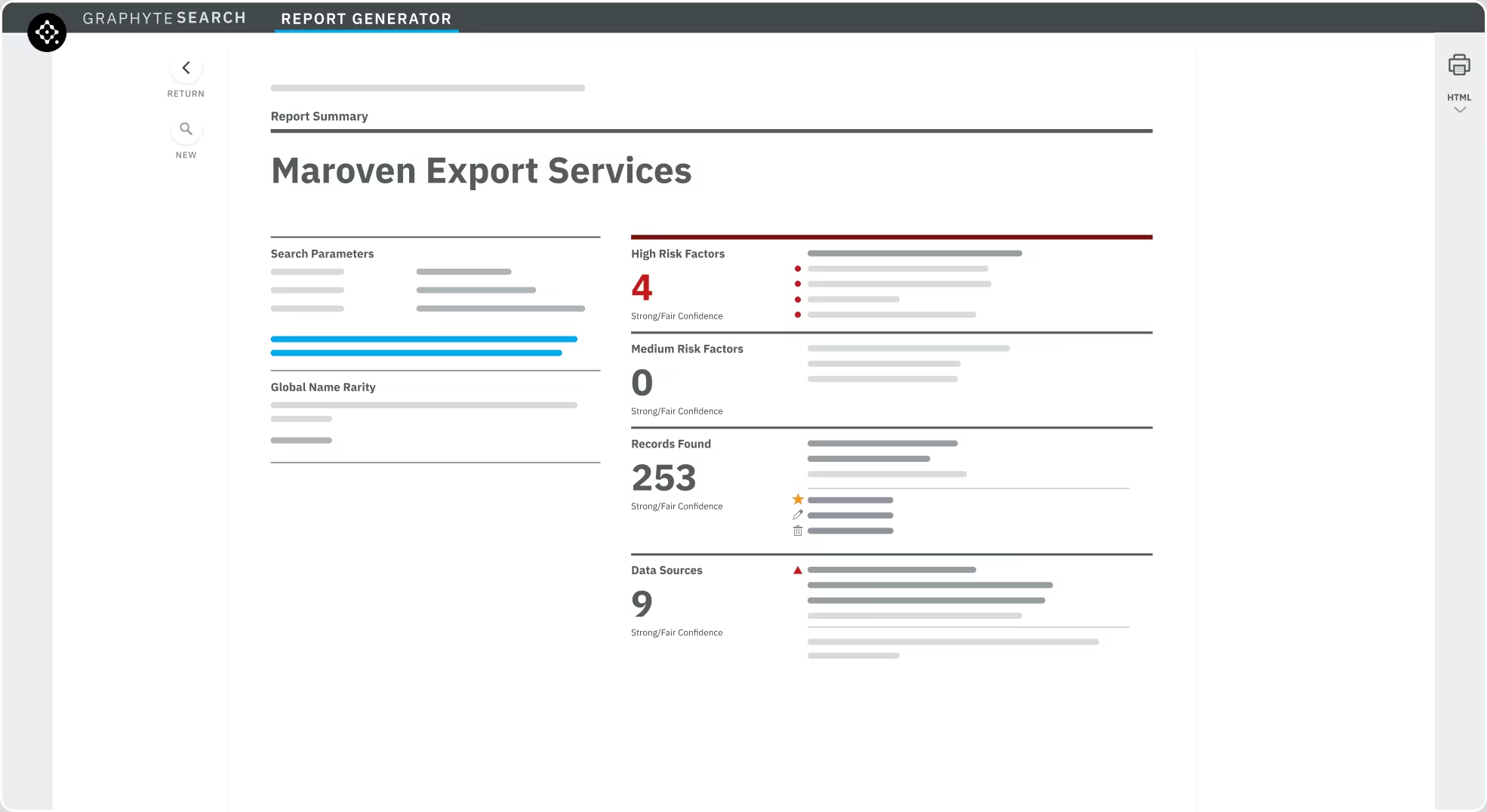
Every decision comes with evidence, source attribution, typology, and confidence. Our reports are ICS-206 compliant, providing a full chain of custody (user, timestamp, and customer) and machine-learning citations that are regulator-ready before they reach the case file.

The Typology Library
60+ AI/ML models score every alert against a living library of financial crime typologies — the ones your regulator reads about in FinCEN advisories.
Sanctions, PEPs, watchlists, registries, and adverse media in 9 languages — one query. Graphyte processes 2,000+ searches daily per customer, providing a comprehensive risk lens across global datasets in seconds.
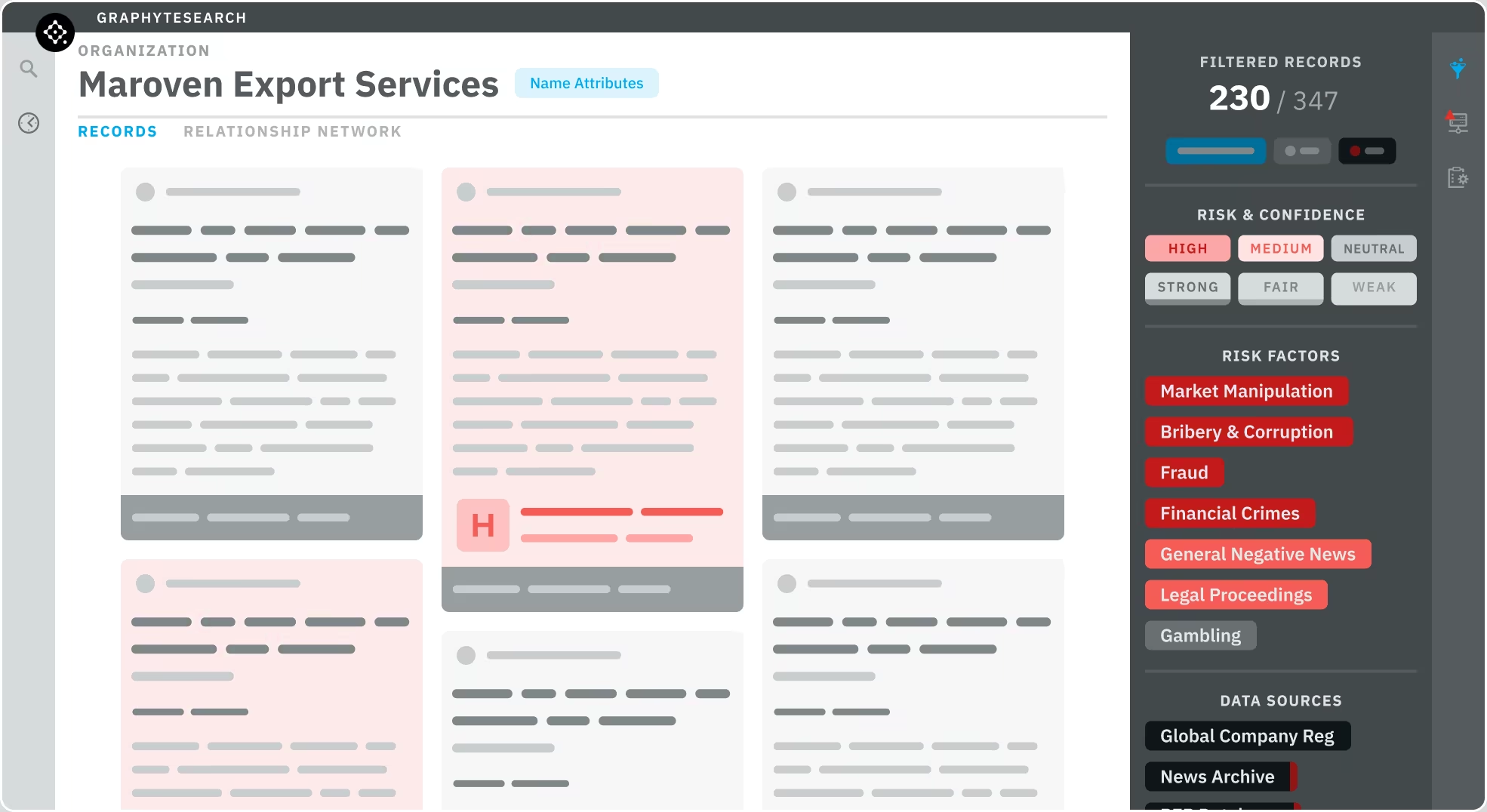
Our entity resolution models have successfully rescored 400,000+ alerts for major financial institutions, dramatically reducing false positives and clearing years of backlog in weeks.
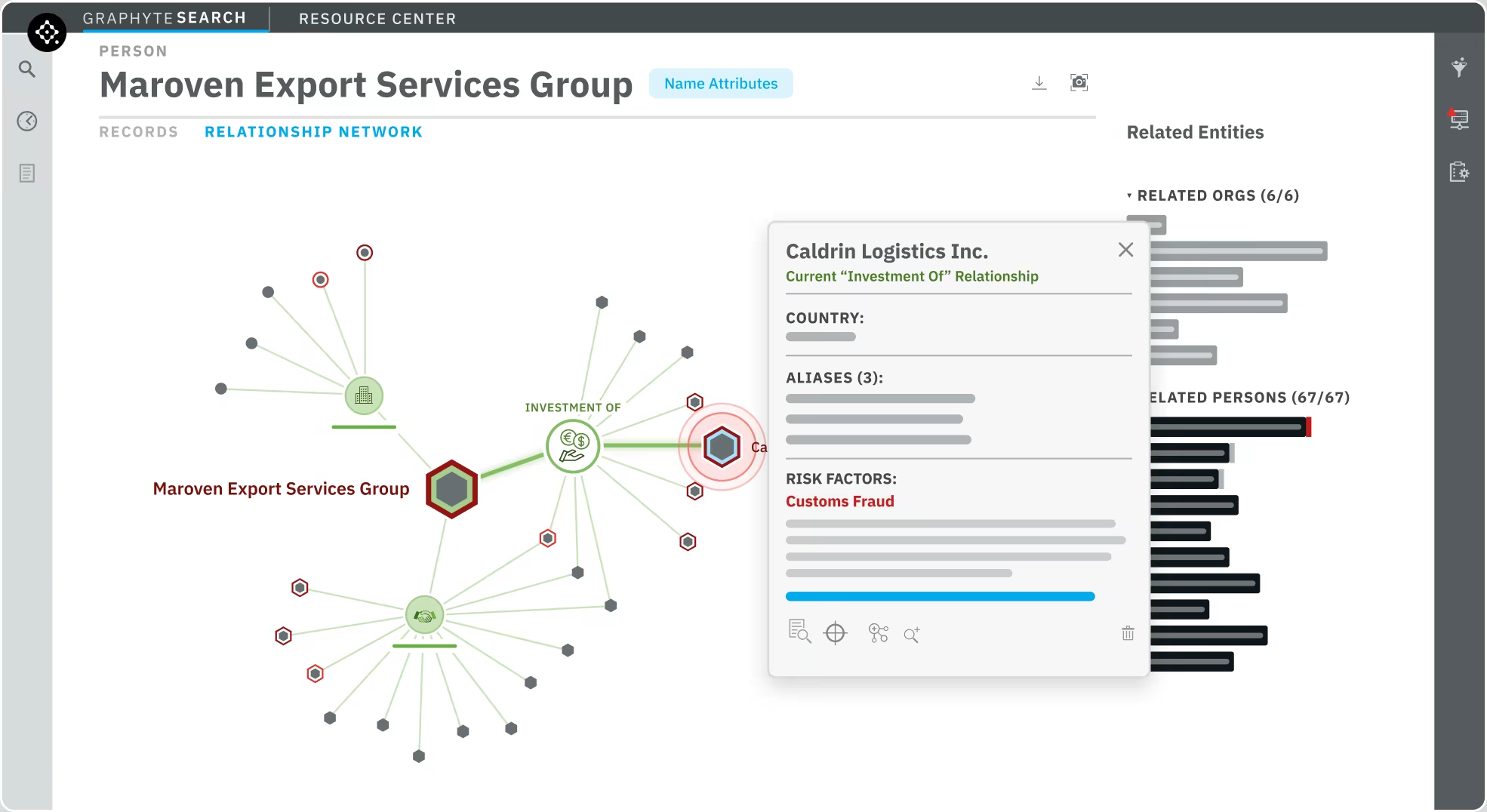
Evidence attached before model-risk review or the regulator asks. Every report features machine-learning citations and 100% traceable. Every signal is tied to its source and evidence.

Accuracy
fewer false positives, fewer misses

Speed
answers in seconds, not weeks

Scale
billions of records, continuously

Explainability
every signal traces to evidence
Proof You Can Take to the Board
$177.9M
in annual alert-processing costs a Tier 1 bank could save across KYC and sanctions alone — independent Celent economic analysis. In production: 90% of risk cases auto-resolved · 96% precision in escalated matches · 2M entities evaluated.
How every number is proven:
The $177.9M figure is Celent’s math, not ours.
Stats from live enterprise deployments, not labs.
Graphyte on your data, benchmarked, before you buy.