Sanctions compliance has never been more complex, or more globally fragmented.
The United States continues to expand its use of secondary sanctions. The European Union enforces blocking statutes that limit compliance with certain U.S. rules. The UK and other jurisdictions have introduced their own designations and enforcement strategies. What was once a relatively aligned global approach has become a patchwork of overlapping, conflicting mandates.
For compliance teams, this divergence creates growing uncertainty and risk. To help illustrate how sanctions regimes have evolved over the past decade, we’ve created a simple interactive map showing where the U.S., EU, UK, and UN have aligned or diverged in their designations from 2013 to 2025.
While this post focuses on sanctions and the challenge it represents — making confident, real-time decisions in the face of regulatory complexity — is something Quantifind helps solve across the entire financial crime lifecycle. Quantifind helps clients navigate the complex sanctions landscape by using transparent AI within a wide range of compliance solutions, including Know Your Customer, Sanctions Compliance, Transaction Intelligence, Investigations, and Third-Party Risk Management.
See the Sanctions Divergence Map
Explore where and when the world’s major sanctions regimes converged or fractured over time. Click through each year to see how regulatory alignment has shifted since 2013.
The map could not be loaded. Please reload this page.
This map focuses on country-level designations, not individual sanctions. It gives compliance professionals a quick, visual sense of how geopolitical complexity translates into screening challenges. It also highlights why a one-size-fits-all approach no longer works.
Why Sanctions Diverge
To understand the fractured sanctions landscape, it helps to look at the types of sanctions regimes in play and how each can create divergent obligations.
When jurisdictions take different approaches — for example, when the U.S. designates a Russian bank but the EU does not — institutions face complex decisions around screening policy, risk tolerance, and legal exposure.
Divergence Creates Real Compliance Risk
This fragmentation introduces uncertainty at every level of the compliance process. What counts as a match? Which lists apply in which region? What happens when one regime’s sanctions contradict another’s?
Without a clear strategy, teams are left asking:
And perhaps most importantly, are we confident in the decisions we’re making?
A More Strategic Approach to Sanctions Screening
Quantifind helps financial institutions adapt to this complexity with precise, policy-aligned screening that reflects the nuances of global regulation. Here’s how:
Smarter Entity Resolution, Driven by Name Science
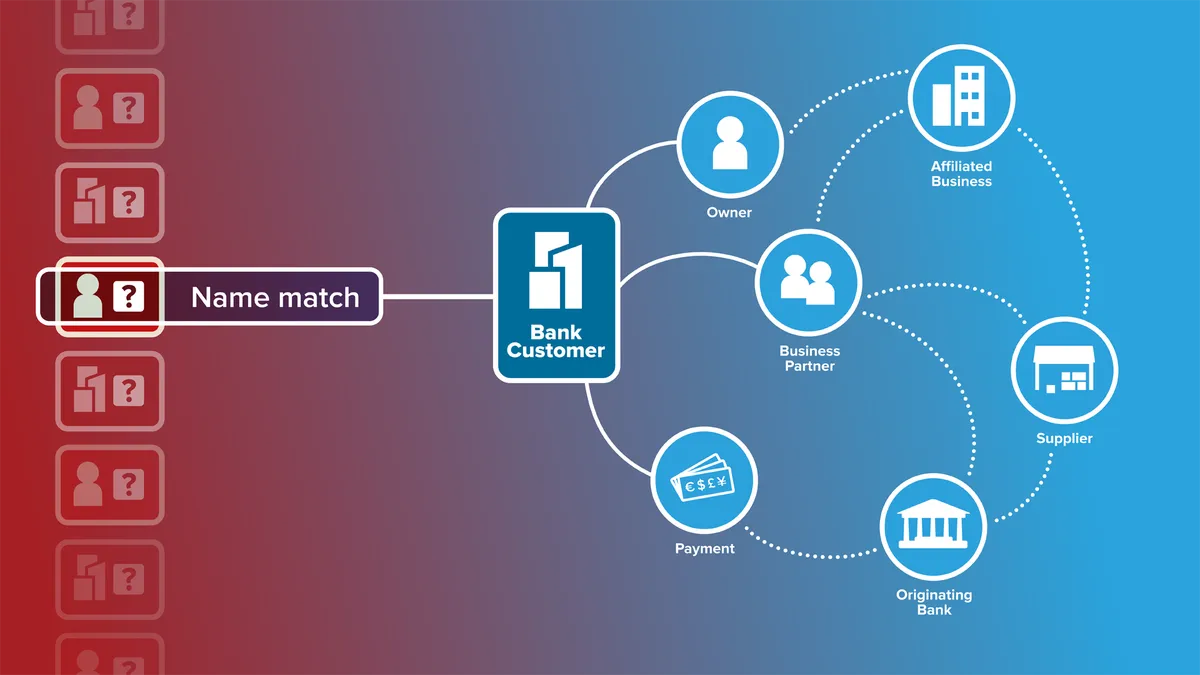
Effective sanctions screening depends on knowing exactly who you’re screening. The problem? The same person or organization can appear under different names — across OFAC, EU, UN, and UK lists, as well as within your own systems.
Quantifind solves this with AI-powered entity resolution built on proprietary Name Science. It handles multilingual variations, predicts likely name patterns, scores name rarity, and pulls in metadata to boost match confidence.
The result: cleaner data, fewer false positives (often reduced by 70% or more), and alerts that actually matter, not duplicates that waste time.
Jurisdiction-Specific Screening That Reflects Your Real Risk
Rather than forcing a universal rulebook, Quantifind enables tailored configurations. You can apply different lists and risk logic by geography, business line, or policy decision. For example:
This flexibility ensures compliance without overreach, and it extends well beyond the scope of sanctions. Think of Quantifind as your risk intelligence advisor: we provide the tools, data, and models, but you set the strategy. You decide how to tune risk settings to fit your policies, markets, and risk appetite.
Granular Filtering for Real-Time and Batch Workflows
Whether you’re screening a single entity via API or processing millions of records in batch, Quantifind allows teams to define what gets flagged:
This fine-tuned control reduces noise and improves efficiency.
Dynamic Monitoring That Adapts by Region and Risk
Compliance isn’t static. Quantifind supports always-on, configurable monitoring so you can:
Seamless Integration Into Your Environment
Quantifind is designed for flexibility and speed. Whether used via API, as a standalone tool, or embedded in your case management system, our platform fits into existing workflows with ease.
Behind the scenes:
Focus Where It Counts
Sanctions regimes will continue to evolve and diverge. Quantifind gives your team the tools to navigate that divergence with confidence.
By delivering explainable results, fewer false positives, and risk-aligned decisions, we help institutions:
Want to see how this approach works across your full compliance stack, from KYC to Transaction Monitoring to Third Party Risk? Let’s talk.
Sanctions Data Sources: OFAC, EU Sanctions Map, UK OFSI, UN Security Council.